
Date
Recent and Upcoming Presentations and Webinars
Webinar/Presentation Slides
26 September 2026
Detroit, USA
Vision, Policy and Skill-set for a Knowledge Economy
Keynote Speech, AABEA Convention, Detroit, MI
A knowledge economy requires alignment across vision, policy, and continuously renewed skills—technology alone is insufficient. Leaders should build an inclusive ecosystem of access, institutions, innovation, capabilities, and diffusion, then execute through measurable missions and public accountability. This talk focuses on the following.
- Which ecosystem layer is the biggest constraint in the target country or community?
- What single mission should leaders launch early on?
- Which metrics would prove the strategy is creating shared prosperity—not merely technology adopti
Saifur Rahman, PhD
Joseph Loring Professor of Electrical Engineering and
Director
, Virginia Tech Advanced Research Institute, USA
2023 IEEE President
29 July 2026
IEEE
Technology for Climate Solutions
Presentation, Science Policy Interface, IYNC and IEEE Technology for a Sustainable Climate
This presentation focuses on how researchers, engineers, scientists, policymakers can benefit from technology that helps address one of the defining challenges of our time – high CO2 emissions. There are innovative solutions spanning the full breadth of climate-relevant technology: from low-carbon energy and sustainable transportation to smart infrastructure, and climate policy. This also highlights IEEE’s engagement with international organizations, policy makers, industry and academia through collaborative symposiums, workshops, and invited lectures.
Saifur Rahman, PhD
Joseph Loring Professor of Electrical Engineering and
Director
, Virginia Tech Advanced Research Institute, USA
2023 IEEE President
17 June 2026
Bangladesh
Technology Options to Address Climate Change Mitigation Needs
Keynote Speech, Pabna University of Science & Technology, Bangladesh
This lecture explains what carbonization is, addresses its causes and impacts. It then offers technological solutions to reduce CO2 emissions from the electric power sector which is responsible over 30% of global Carbon emissions. In order to address the reduction of carbon emissions from the electric power sector, a collaborative approach between the industrialized nation states and emerging economies is necessary. This will involve a portfolio of solutions with low-carbon generation from wind, solar, hydro and nuclear, storage, cross-border power transfer and advanced technology focusing on energy efficiency. This talk also discusses the IEEE Climate Change program and related activities.
Saifur Rahman, PhD
Joseph Loring Professor of Electrical Engineering and
Director
, Virginia Tech Advanced Research Institute, USA
2023 IEEE President
8-10 June 2026
Morocco
Digital Twins: Situational Awareness and Technology Solutions Through Virtual Intelligence
Keynote Speech, IEEE World Technology Summit for Digital Twins, Rabat, Morocco
Saifur Rahman, PhD
Joseph Loring Professor of Electrical Engineering and
Director
, Virginia Tech Advanced Research Institute, USA
2023 IEEE President
7 April 2026
USA
An Intelligent Digital Twin Simulator for a College-town Power System
Keynote Speech, CSER Conference, George Mason University, Arlington, VA
Blacksburg is a college-town whose electric network is operated by Virginia Tech Electric Service (VTES). The system supplies power to the Virginia Tech campus and a large portion of the surrounding town. VTES receives bulk power from Appalachian Power (AEP) at 66 kV. The voltage is stepped down at four substations to 11 kV for primary distribution. These feeders serve campus facilities, residential streets, commercial customers, and small industrial loads. This layered structure represents a typical yet highly dynamic distribution system, where load behavior, increasing rooftop solar PV, distributed energy resources, and operational limits constantly influence each other. Renewable energy sources, battery energy storage systems, and electrified loads such as EV charging introduce variability, bidirectional power flows, and tighter voltage margins. This project is geared to developing tools that reflect the live-state of the system and anticipate what may happen next. An Intelligent Digital Twin Simulator (IDTS) offers this capability which is a continuously synchronized virtual replica of the physical network. It evaluates “what-if” scenarios under realistic constraints. It acts as a decision support engine rather than a visualization tool.
This keynote presents a practical framework for deploying an IDTS in the Blacksburg / VTES environment. The talk begins with the digital core: a feeder-level network model, asset representations, and a measurement mapping layer. It then discusses real-time functions such as streaming data ingestion, distribution-aware state estimation, and unbalanced load flow. Building on this foundation, the intelligence layer introduces short-term load forecasting, renewable generation prediction, anomaly detection, and fast surrogate models for accelerated analysis. The presentation highlights high-value applications relevant to a college-town utility. These include peak demand management, voltage regulation, DER coordination, reliability enhancement, outage response support, and battery dispatch strategies. Operators can evaluate contingencies and switching actions before execution. Ultimately, the Intelligent Digital Twin Simulator transforms how a local power system is understood, operated, and planned.
Saifur Rahman, PhD
Joseph Loring Professor of Electrical Engineering and
Director
, Virginia Tech Advanced Research Institute, USA
2023 IEEE President
15 November 2025
COP30, Belem, Brazil
Role of Cross-border Power Transfer in Energy Transition
Keynote Speech, Strengthening Capacity Building for Energy Transition
Hosted by GEIDCO, UNFCCC and PCCB
This paper highlights how cross-border power transfer can help promote energy transition. While the traditional concept of using renewable energy to displace fossil fuel-based energy helps with the target of promoting carbon-free electricity, there is another alternative – cross-border power transfer – which can help with achieving the same goal. Examples are given from North America (Canada-US), Europe (France-Portugal-Spain), Africa (Ethiopia-Kenya) and Asia (Laos-Thailand-Malaysia-Singapore) where cross-border power transfers are taking place avoiding the use of fossil fuel-based electricity to meet the national electricity needs of the recipient countries. The issue of capacity building to facilitate technology deployment for cross-border power transfer is also discussed
Saifur Rahman, PhD
Joseph Loring Professor of Electrical Engineering and Director
Virginia Tech Advanced Research Institute, USA
IEEE President 2023
06 November 2025
IEEE Online
Promoting Technology to Achievea Sustainable Climate
Keynote Speech, OFCCT, IEEE Online
Data Centers around the world are heavy users of electricity and water. Industry and governments worldwide are increasingly conscious that DCs cannot continue to grow in an unsustainable manner, without managing their resource footprint. The presentation will use example Data Centers to highlight the sustainability issue.
Saifur Rahman, PhD
Joseph Loring Professor of Electrical Engineering and Director
Virginia Tech Advanced Research Institute, USA
IEEE President 2023
06 November 2025
Faridabad, India
AI Data Center Design and Operation
Invited Talk, Taylor & Francis Conference, Faridabad, India
Data Centers around the world are heavy users of electricity and water. Industry and governments worldwide are increasingly conscious that DCs cannot continue to grow in an unsustainable manner, without managing their resource footprint. The presentation will use example Data Centers to highlight the sustainability issue.
Saifur Rahman, PhD
Joseph Loring Professor of Electrical Engineering and Director
Virginia Tech Advanced Research Institute, USA
IEEE President 2023
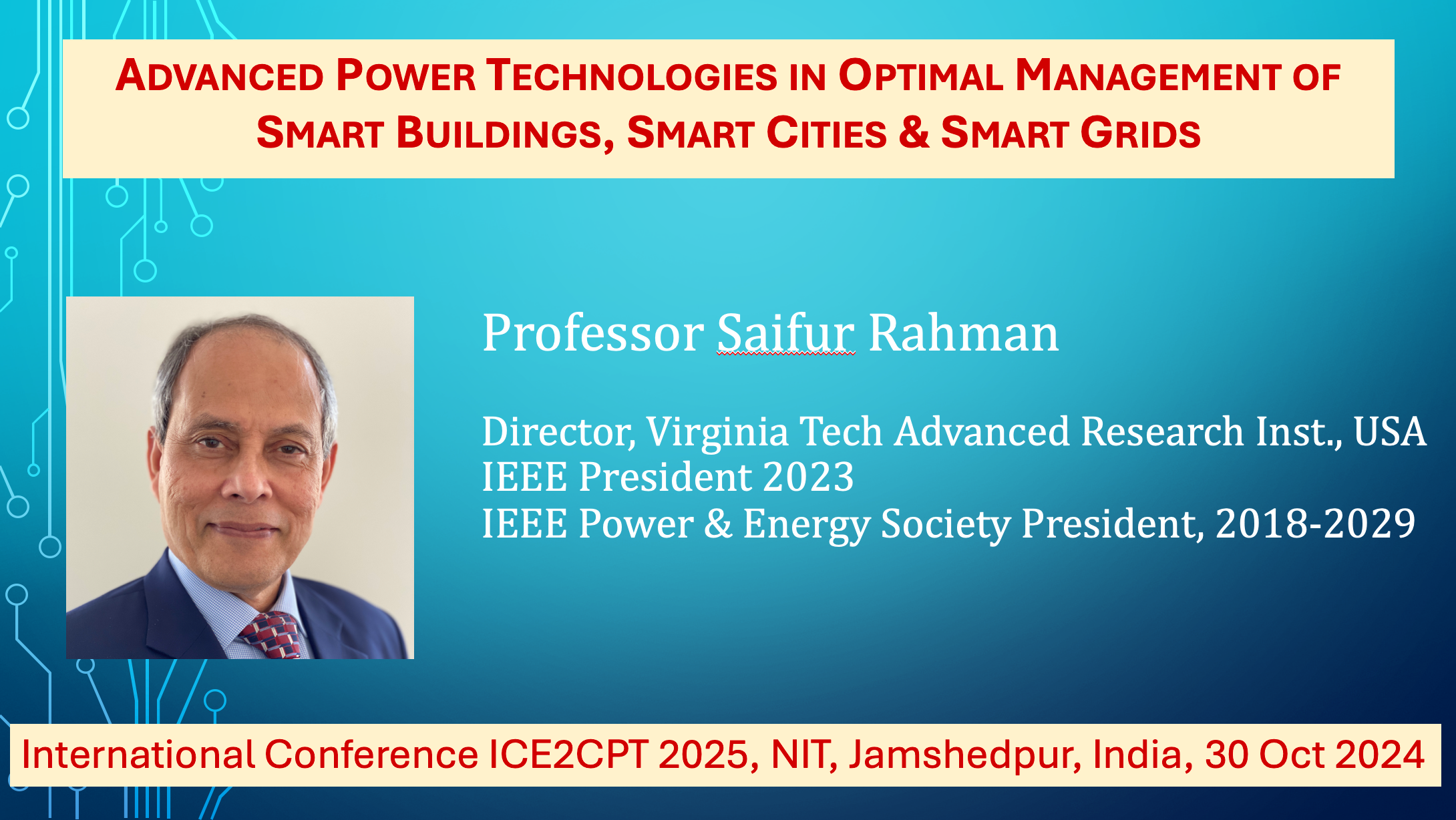
30 October 2025
Jamshedpur, India
Advanced Power Technologies in Optimal Managment of Smart Buildings, Smart Cities & Smart Grids
Invited Talk, ICE2CPT 2025, NIT, Jamshedpur, India
This lecture explains the Smart Grid ecosystem comprising of the smart grid, smart city, smart campus and smart building. The ecosystem features bi-directional flows of energy, complex interconnected infrastructures, automation, sensors and smart devices.
Saifur Rahman, PhD
Joseph Loring Professor of Electrical Engineering and Director
Virginia Tech Advanced Research Institute, USA
IEEE President 2023
28 October 2025
Saudi Arabia
Technology’s Role in Decarbonization in the Electric Power Sector
Keynote Speech, SENZE’25, Hail, KSA
This lecture explains what carbonization is, addresses its causes and impacts. It then offers technological solutions to reduce CO2 emissions from the electric power sector which is responsible over 30% of global Carbon emissions. In order to address the reduction of carbon emissions from the electric power sector, a collaborative approach between the industrialized nation states and emerging economies is necessary. This will involve a portfolio of solutions with low-carbon generation from wind, solar, hydro and nuclear, storage, cross-border power transfer and advanced technology focusing on energy efficiency. This talk also discusses the IEEE Climate Change program and related activities.
26 September 2025
Washington DC
Connecting the Unconnected: Solving the Last-Mile Challenge
Invited Talk, IEEE Connecting the Unconnected (CTU) Summit
Globally there are numerous programs undertaken by UN agencies, national governments and NGOs to give last mile digital access to dispersed communities. The Green Digital Action Program run by the International Telecommunication Union is an example of such activities. The available technologies can be classified as follows.
Wireless Technologies
- Fixed Wireless Access (FWA)
- Mobile Networks (4G, 5G)
- Wi-Fi Mesh Networks
- TV White Space (TVWS)
Satellite Internet
- GEO Satellites (e.g., Viasat, HughesNet)
- LEO Satellites (e.g., Starlink)
Hybrid and Emerging Technologies
- Community Networks
- Balloons/Drones (e.g., Project Loon, HAPS)
- Li-Fi (Light Fidelity)
Choosing the Right Technology Depends On:
- Geography: Terrain, population density.
- Budget: Capital and operational costs.
- Regulation: Spectrum access, permits.
- Speed/Latency Needs: User expectations and application demands.
Saifur Rahman, PhD
Joseph Loring Professor of Electrical Engineering and Director
Virginia Tech Advanced Research Institute, USA
IEEE President 2023
18 September 2025
CIGRE
Technology’s Role in Achieving Climate Sustainability
Invited Talk, CIGRE NGN Webinar
This lecture explains what carbonization is, addresses its causes and impacts. It then offers technological solutions to reduce CO2 emissions from the electric power sector which is responsible over 30% of global Carbon emissions. In order to address the reduction of carbon emissions from the electric power sector, a collaborative approach between the industrialized nation states and emerging economies is necessary. This will involve a portfolio of solutions with low-carbon generation from wind, solar, hydro and nuclear, storage, cross-border power transfer and advanced technology focusing on energy efficiency. This talk also discusses the IEEE Climate Change program and related activities.
Saifur Rahman, PhD
Joseph Loring Professor of Electrical Engineering and Director
Virginia Tech Advanced Research Institute, USA
IEEE President 2023

10 September 2025
Beijing, China
Role of Technology in Achieving Climate Resilience
Invited Talk, Tsinghua University Colloquium
This lecture explains what carbonization is, addresses its causes and impacts. It then offers technological solutions to reduce CO2 emissions from the electric power sector which is responsible over 30% of global Carbon emissions. In order to address the reduction of carbon emissions from the electric power sector, a collaborative approach between the industrialized nation states and emerging economies is necessary. This will involve a portfolio of solutions with low-carbon generation from wind, solar, hydro and nuclear, storage, cross-border power transfer and advanced technology focusing on energy efficiency. This talk also discusses the IEEE Climate Change program and related activities.
Saifur Rahman, PhD
Joseph Loring Professor of Electrical Engineering and Director
Virginia Tech Advanced Research Institute, USA
IEEE President 2023
09 September 2025
Beijing, China
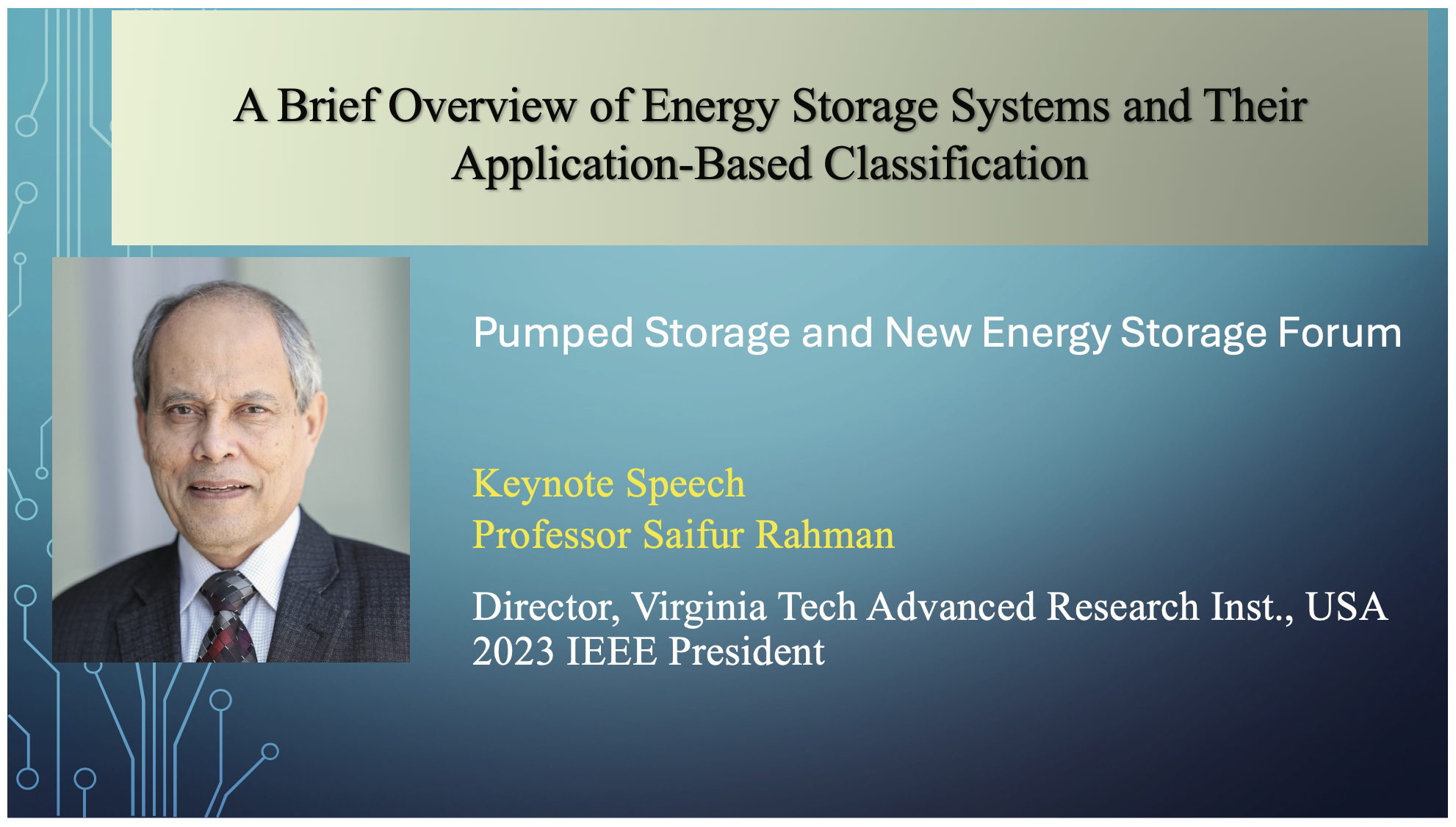
A Brief Overview of Energy Storage Systems and their Application-Based Classification
Keynote Speech, GEI Conference on Pumped Storage and New Energy Storage Forum, Beijing China.
Pumped hydro storage (PHS) is one of the most widely used mechanical energy storage systems. PHS accounts for over 94% of the world’s installed energy storage capacity. This stores electrical energy by using the potential energy of water. During low-demand hours, the water is pumped and stored in an upper reservoir. When the demand is high, this stored water is released and converted into electrical power with good efficiency (around 70 to 85%).
Major Energy Storage System technologies are:
• Pumped Hydro Storage (PHS) Systems
• Compressed Air Energy Storage Systems (CAES)
• Flywheel Energy Storage Systems
• Battery Energy Storage Systems (BESS)
Energy storage is critical in power systems for several reasons:
• Balancing Supply and Demand
• Mitigating Intermittency of Renewable Energy Sources
• Peak Load Management
• Grid Stability and Reliability
• Energy Arbitrage
• Resilience and Backup Power
• Transmission and Distribution Support
• Microgrids and Off-Grid Applications
• Energy Efficiency
• Ancillary Services (frequency control, spinning reserves, and energy trading)
• Decarbonization
Saifur Rahman, PhD
Joseph Loring Professor of Electrical Engineering and Director
Virginia Tech Advanced Research Institute, USA
2023 IEEE President & CEO
Click here for August 2025 and earlier Webinars